Meaning of Inflation
Inflation is an economic indicator that indicates the rate of rising prices of goods and services in the economy. Ultimately it shows the decrease in the buying power of the rupee. It is measured as a percentage. This percentage indicates the increase or decrease from the previous period. Inflation can be a cause of concern as the value of money keeps decreasing as inflation rises. Inflation is a quantitative economic measure of a rate of change in prices of selected goods and services over a period of time. Inflation indicates how much the average price has changed for the selected basket of goods and services. An increase in inflation indicates a decrease in the purchasing power of money in the economy.
Inflation being a cause of concern for the economy, doesn’t affect everyone in a bad way. It is a boon for a certain set of people. While consumers lose a part of their purchasing power to inflation, investors gain from it. Investors investing in assets affected by inflation, if held on for a long time will certainly benefit from it. For example, an increase in housing prices might affect consumers. However, those who have already bought a house will benefit from capital appreciation.
The inflation rate is calculated by taking the difference between initial CPI and final CPI divided by initial CPI. The result then multiplied by 100 gives the inflation rate.
Mathematically,
Rate of Inflation = (Initial CPI – Final CPI/ Initial CPI)*100 where,
CPI= Consumer Price Index
The above calculation of the inflation rate is done by using the following steps:
- Determine the rate of the product at an earlier period.
- Determine the current rate of the product
- Use the inflation rate formula (Initial CPI – Final CPI/ Initial CPI)*100. Here CPI is the rate of the product.
This gives the increase/decrease percentage in the price of the product. One can use this to compare the inflation rate over a period of time.
How can inflation be prevented?
To prevent inflation, the primary strategy is to change the monetary policy by adjusting the interest rates. Higher interest rates decrease the demand in the economy. This results in lower economic growth and therefore, lower inflation. Other ways to prevent inflation are:
- Controlling the money supply can also help in preventing inflation.
- A higher Income Tax rate can reduce spending, hence resulting in lesser demand and inflationary pressures.
- Introducing policies to increase the efficiency and competitiveness of the economy helps in reducing the long-term costs.
Causes of inflation
Inflation is the increase in the general price level in the economy. It is caused by several economic and non-economic factors. Some key causes of inflation have been mentioned below:
- Monetary Policy: It determines the supply of currency in the market. Excess supply of money leads to inflation. Hence decreasing the value of the currency.
- Fiscal Policy: It monitors the borrowing and spending of the economy. Higher borrowings (Debt), result in increased taxes and additional currency printing to repay the debt.
- Demand-pull Inflation: Increases in prices due to the gap between the demand (Higher) and supply (Lower).
- Cost-push Inflation: Higher prices of goods and services due to increased cost of production.
- Exchange Rates: Exposure to foreign markets are based on the dollar value. Fluctuations in the exchange rate have an impact on the rate of inflation.
Types of inflation by a rate of inflation
There are different types of inflation based on a rate of increase in prices. This also refers to the severity of inflation in the context of an economy. The different types of inflation based on a rate of increase have been mentioned below;
1. Creeping inflation (1-4%)
When the rate of inflation slowly increases over time. For example, the inflation rate rises from 2% to 3%, to 4% a year. Creeping inflation may not be immediately noticeable, but if the creeping rate of inflation continues, it can become an increasing problem.
2. Walking inflation (2-10%)
When inflation is in single digits – less than 10%. At this rate – inflation is not a major problem, but when it rises over 4%, Central Banks will be increasingly concerned. Walking inflation may simply be referred to as moderate inflation.
3. Running inflation (10-20%)
When inflation starts to rise at a significant rate. It is usually defined as a rate between 10% and 20% a year. At this rate, inflation is imposing significant costs on the economy and could easily start to creep higher.
4. Galloping inflation (20%-1000%)
This is an inflation rate of between 20% to 1000%. At this rapid rate of price increases, inflation is a serious problem and will be challenging to bring under control. Some definitions of galloping inflation may be between 20% and 100%. There is no universally agreed definition, but hyperinflation usually implies over 1,000% a year.
5. Hyperinflation (> 1000%)
This is reserved for extreme forms of inflation – usually over 1,000% though there is no specific definition. Hyperinflation usually involves prices changing so fast, that it becomes a daily occurrence and under hyperinflation, the value of money will rapidly decline.
Demand-pull inflation
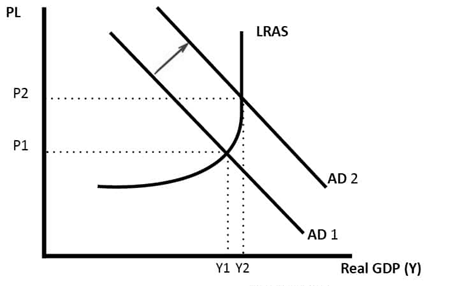
Demand-pull inflation occurs when the demand for goods or services is higher when compared to the production capacity. The difference between demand and supply (shortage) results in price appreciation. This occurs when AD increases at a faster rate than AS. Demand-pull inflation will typically occur when the economy is growing faster than the long-run trend rate of growth. If demand exceeds supply, firms will respond by pushing up prices.
A simple diagram showing demand-pull inflation has been presented below:
Causes of demand-pull inflation
- A growing economy: When consumers feel confident, they spend more and take on more debt. This leads to a steady increase in demand, which means higher prices.
- Increasing export demand: A sudden rise in exports forces an undervaluation of the currencies involved.
- Government spending: When the government spends more freely, prices go up.
- Inflation expectations:Companies may increase their prices in expectation of inflation in the near future.
- More money in the system: An expansion of the money supply with too few goods to buy makes prices increase.
Cost-push Inflation
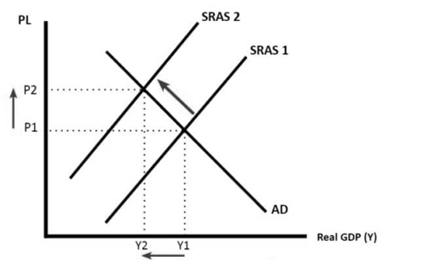
Cost-push Inflation occurs when the cost of production increases. An increase in prices of the inputs (labor, raw materials etc.) increases the price of the product. This occurs when there is an increase in the cost of production for firms causing aggregate supply to shift to the left. Cost-push inflation could be caused by rising energy and commodity prices.
A diagram showing cost-push inflation has been presented below:
Causes of Cost-Push Inflation
1. Monopoly
Companies that achieve a monopoly in an industry can create cost-push inflation. A monopoly reduces supply to meet its profit goal.
A good example is the Organization of Petroleum Exporting Countries (OPEC). It sought monopoly power over oil prices. Before OPEC, its members competed with each other on price. They didn’t receive a reasonable value for a non-renewable natural resource.
2. Wage Inflation
Wage inflation occurs when workers have enough leverage to force through wage increases. Companies then pass higher costs through to consumers.
3. Natural Disasters
Natural disasters cause inflation by disrupting supply. A good example is right after Japan’s earthquake in 2011. It disrupted the supply of auto parts. It also occurred after Hurricane Katrina. When the storm destroyed oil refineries, gas prices soared.
4. Government Regulation and Taxation
A fourth driver is government regulation and taxation. These rules can reduce supplies of many other products. Taxes on cigarettes and alcohol were meant to lower the demand for these unhealthy products. That may have happened—but more importantly, it raised the price and created inflation.
5. Exchange Rates
The next reason is a shift in exchange rates. Any country that allows the value of its currency to fall will experience higher import prices. The foreign supplier does not want the value of its product to drop along with that of the currency. If demand is inelastic, it can raise the price and keep its profit margin intact.
The effects of a rise in the inflation rate
As mentioned earlier, inflation is caused by different factors. It is mainly induced by either demand-pull or cost-push factors in an economy. Moreover, the major effect of a rise in inflation rates in an economy can be listed as under:
- A rise in an inflation rate can cause more than a fall in purchase power.
- Inflation could lead to economic growth as it can be a sign of rising demand.
- Inflation could further lead to an increase in costs due to workers’ demand to increase wages to meet inflation. This might increase unemployment as companies will have to lay off workers to keep up with the costs.
- Domestic products might become less competitive if inflation within the country is higher. It can weaken the currency of the country.